Drift Toward the Shoulder
On a straight stretch of the E11 or E22, the car slowly moves toward one lane edge with your hands relaxed. Toe or camber errors cause it, though uneven tyre pressure can mimic the pull.
We set camber, caster and toe on all four wheels, balance every rim and road test the car, so it holds a straight line at 140 km/h on the E22 without constant correction.
5-star on Google · 87 reviews
The facts
Misalignment is a common route to a tyre fine. A toe or camber error wears one shoulder of the tread bald while the centre still looks legal from the kerb. By the time the driver notices, the tyre fails a police check, which costs Dh500, four black points and a seven day impoundment.
Abu Dhabi Police also rule that a tyre's production date must be no more than five years old, whatever its tread looks like. Correct wheel alignment in Abu Dhabi keeps the wear even, so a tyre reaches that age safely.

Know the signs
These 5 signs show up first on fast, straight Abu Dhabi highways, where small angle errors are easiest to feel.
On a straight stretch of the E11 or E22, the car slowly moves toward one lane edge with your hands relaxed. Toe or camber errors cause it, though uneven tyre pressure can mimic the pull.
A steering wheel that shakes between 100 and 140 km/h usually points to wheel balance, not alignment. A lost weight or a rim bent by a kerb is the common cause.
The inside edge wears smooth while the outer tread looks fine. Negative camber or toe out causes this, and it hides from a quick walk around the car.
The car feels nervous and needs constant small corrections at highway speed. Low caster on one side or worn steering joints reduce the self centring that keeps the wheel steady.
Drivers often notice a pull after a weekend on sand or a hard landing off a dune. The impact shifts toe settings or bends a tie rod without leaving a visible mark.
Every wheel alignment in Abu Dhabi we carry out follows the factory data for your exact model and trim.
We measure both axles and set the rear first, giving the front a true reference. This suits cars with independent rear suspension, from sedans to large SUVs.
We spin each wheel on a balancer that reads imbalance on the inner and outer planes, then fit new weights to bring both within tolerance and remove highway shimmy.
On cars with a fixed rear axle, we set the front wheels to the line the rear axle points along. The car then tracks straight even with limited rear adjustment.
Air suspension on Range Rover, Mercedes-Benz GLS and Lexus LX models changes geometry with height. We set the factory ride height first, then align at that exact position.
Stability control relies on knowing where the wheels point. After adjustment, we recalibrate the steering angle sensor, so lane assist and stability systems read straight ahead correctly.
Abu Dhabi Police advise rotating tyres about every 10,000 km. We rotate in the pattern your tyres and drivetrain allow, then set pressures cold.
Speed limits on the main routes out of Musaffah changed on 9 February 2026. The E22 now runs at 140 km/h between the Al Nahda and Bani Yas interchanges and 120 km/h from Bani Yas to the Bridge Complex. Al Rawdah Road (E30) beside Musaffah dropped from 120 to 100 km/h. A trip to Al Ain covers about 143 km and Liwa sits about 200 km away, so small geometry errors add up to real tread loss on every run.
| Fault | What You Feel at 120 to 140 km/h | Effect on the Tyre | What We Adjust |
|---|---|---|---|
| Toe out of range | Steady pull and a crooked steering wheel | Feathered tread across the ribs | Tie rod length on each side |
| Excess negative camber | Little change in feel | Bald inner shoulder | Camber bolts, arms or strut tops |
| Uneven caster | Pull toward one side and vague centring | Faster wear on one front tyre | Mounting points and control arm bushes |
| Thrust angle error | Car crabs slightly with the wheel off centre | Rear tyres scrub sideways | Rear toe first, then front set to the thrust line |
| Wheel imbalance | Shake through the wheel or seat | Cupped, patchy tread | Computerised balancing with new weights |
Heat makes each fault worse. A tyre that scrubs sideways runs hotter, and asphalt on a 46 °C afternoon already pushes tread temperatures up. The two together explain why worn shoulders appear so fast on Abu Dhabi highway cars. In summer 2026, Abu Dhabi Police released footage of real tyre failure crashes, and a local garage told The National that more drivers were arriving with damaged, worn or underinflated tyres.
Step by step
We read tread depth, wear pattern and the production date on each sidewall, then set cold pressures. A soft tyre gives false readings, so we send a slow leak to tyre puncture repair first.
We check ball joints, tie rod ends and bushes for play, and we report and quote any worn part before we touch a single setting.
We clamp camera targets onto each rim, and our aligner reads camber, caster and toe at every corner against your maker's data.
Our technician sets rear camber and toe first, then front caster, camber and toe, in the order your maker specifies.
We reset the steering angle sensor with diagnostic software, then confirm on a road test that the wheel sits level. You keep the before and after printout.
Every factory alignment sheet gives each angle a target and a tolerance window, and we set the car inside that window, close to the middle. The table shows the ranges a typical factory sheet gives for a modern car with independent suspension. Exact numbers differ by model, so we load the data for your make, model and trim.
| Angle | What It Controls | Typical Front Spec | Typical Rear Spec | Typical Left to Right Limit |
|---|---|---|---|---|
| Camber | Tyre tilt seen from the front, and which shoulder carries the load | Slightly negative, about minus 0.3° to minus 0.9°, within about ±0.4° | About minus 1.0° to minus 2.0°, within about ±1.0° | About ±0.2° to ±0.6° front, up to ±0.8° rear |
| Caster | Steering axis tilt, which gives self centring and straight line stability | About 4° to 6° positive, within about ±0.5° to ±1.0° | Not applicable | About ±0.2° to ±1.0° |
| Toe (each wheel) | Whether each tyre points in or out, the biggest factor in tread wear | Close to zero, within about ±0.15° | Slight toe in, around 0.2°, within about ±0.15° | About ±0.1° |
Some makers set their figures with ballast on the front seats to copy a driver and passenger, and we load the car the same way when a maker asks for it. The left to right limit matters as much as the main value. A car with both sides inside spec but a large caster split still pulls toward the side with less caster.
The thrust line is the direction the rear wheels push the car. When rear toe differs from side to side, that line points away from the car's centreline, and the body crabs down the road with the steering wheel off centre. We set rear toe first to bring the thrust angle close to zero, then align the front wheels to it.
Our printout lists each angle before and after adjustment, next to the maker's tolerance window. You see exactly which angle was out, by how much, and where we set it.
Lane keeping cameras and radar cruise sensors aim along the car's thrust line. An alignment that moves the thrust angle or the steering wheel centre also moves the direction these sensors assume is straight ahead. That is why we always align before any ADAS calibration, because the thrust line has to match the maker's specification first.
Common triggers are a wheel alignment, steering or suspension parts replaced in a way that changes alignment, and a new windscreen. Requirements differ by maker. Some call for calibration after every alignment, while others only when their service information says so, and we check the rule for your model.
A static calibration uses printed targets set at measured distances in front of the car, with the scan tool guiding the camera to them. A dynamic calibration runs while the car drives on clearly marked roads at a set speed. Your maker's procedure decides which one applies.
A camera that is out of aim often shows no warning at all. Many cameras also learn small offsets to cover tyre and suspension wear, and those learned values need a reset once the alignment is corrected.
Alignment rarely drifts on its own, because an impact usually moves it. These are the 4 impacts that come up again and again at our Musaffah workshop.
Dune Driving: Low tyre pressures and hard landings on sand load the steering joints far beyond normal road use.
Kerb Strikes: Tight parking in villa compounds and malls ends with a wheel climbing a kerb, which bends tie rods and knocks toe out.
Speed Bumps: Crossing at speed or at an angle sends a sharp load through ball joints and control arm bushes.
Potholes and Debris: Heavy vehicle routes around industrial zones carry broken patches that hit a wheel hard even at low speed.
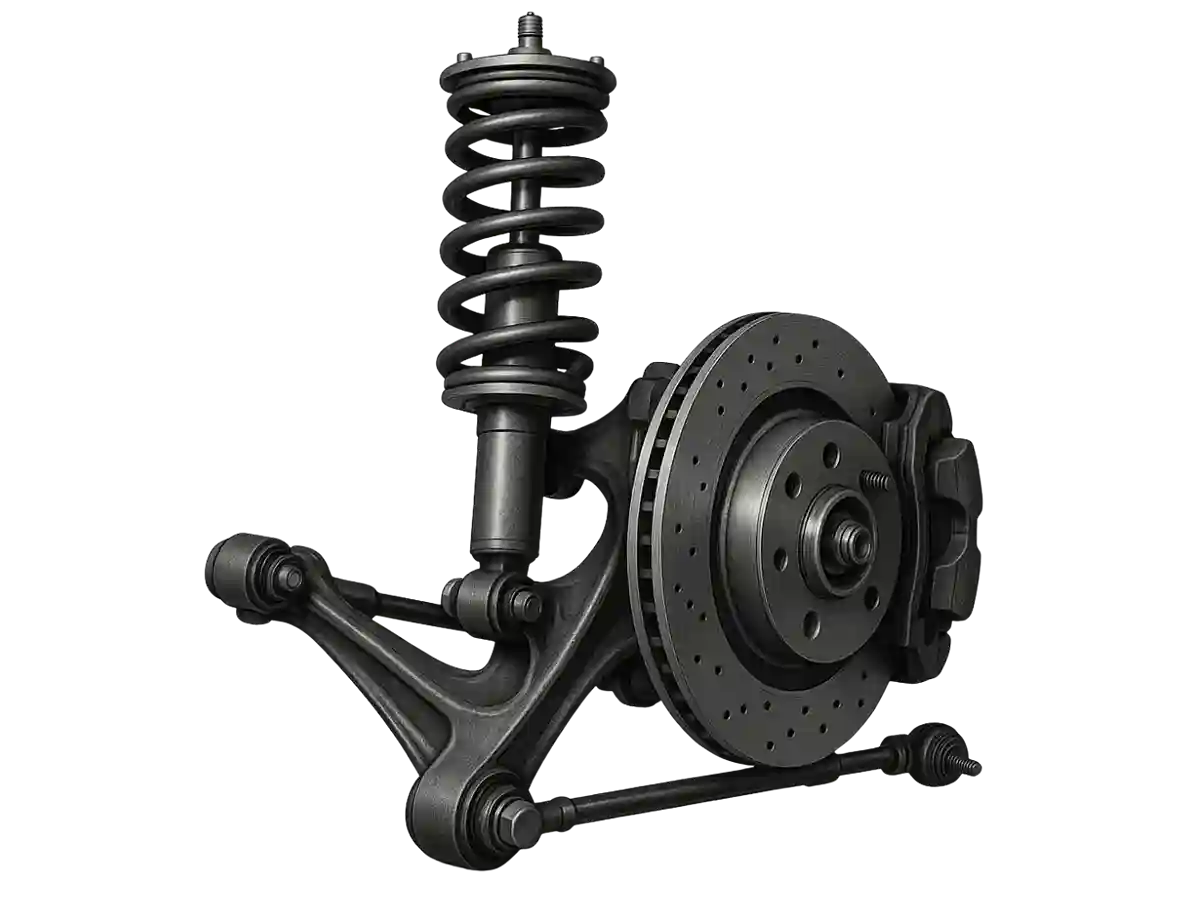
One hard hit is enough to move the settings, so we recommend a check after any of these to protect the tyres. Worn bushes also let the angles change under load, and our car suspension repair team replaces them before we align. If we find a noisy hub during the check, we carry out the wheel bearing replacement on the same visit.
Why 800 Exotic
We set every angle to your maker's published tolerance for the exact model and trim, not a generic value, and print the before and after readings for your records.
Our MOIAT certified mechanics check every ball joint, tie rod end and bush for play first, because no alignment holds for long on worn parts at highway speeds.
We align and balance in one visit, so we fix a highway shimmy and a steady pull together instead of across two separate bookings at different shops.
We charge up to 30% below main dealer pricing for the same factory data, and you approve a quote before we turn any adjuster bolt on your car.
We give each job a written warranty covering the adjustment and any steering or suspension part we fit, and we name the part source clearly on the invoice.
We have repaired more than 50,000 vehicles in over 15 years as a group, and our Google rating stands at 5.0★ from 87 reviews, every single one of them five stars.
Abu Dhabi · Musaffah
Our Musaffah Industrial workshop on Al Hasheemah 4 St sits beside the E30, about 10 km from MBZ City centre and 15 km from Khalifa City. Shakhbout City is about 20 km away, and Bani Yas about 21 km via the E22. Drivers from Al Reem Island, the Corniche and Yas Island travel 28 to 32 km, roughly 25 to 30 minutes outside rush hour.
We collect for free on routine alignment visits, so island residents skip the drive entirely. After a hard kerb or pothole impact, our recovery trucks bring in a car that pulls badly or has a damaged wheel. We handle any other car repair in Abu Dhabi the inspection uncovers at the same workshop.
If you are based in Dubai, you can book wheel alignment in Dubai at our Al Quoz head office instead. We work from the same factory geometry data in both cities.
Find our Musaffah workshop on Google Maps DubaiAl Quoz
 Abu DhabiMusaffah
 SharjahIndustrial Area 10
Send us your model and tyre size on WhatsApp, and we reserve an alignment slot and check every tyre free of charge.
Answers
We recommend a check every 10,000 km, in line with the rotation interval Abu Dhabi Police recommend, and after any kerb strike, pothole hit or desert trip. New tyres also justify a check from the first kilometre.
Yes, indirectly. Misalignment wears the tread edge bald, and worn or unsafe tyres carry a Dh500 fine, four black points and a seven day impoundment. Abu Dhabi issued 26,413 of the UAE's roughly 37,900 such fines in 2024 under the Federal Traffic Law.
Yes. We balance every wheel on a computerised machine at our Musaffah workshop, usually alongside alignment. Shake at 100 to 140 km/h points to balance, while a steady pull points to alignment.
Yes. Low pressures and hard landings on sand load tie rods and ball joints heavily. A quick measurement shows whether toe or camber moved, and we reinflate the tyres to road pressure.
Abu Dhabi Police say a tyre's production date must be no more than five years old, regardless of tread. Buy new tyres within one year of production, and we read the date code during every alignment.
It depends on the maker. Some require camera and radar calibration after every alignment, and others only when their service information says so. We check the rule for your model and set the thrust angle to spec first.
We finish a standard four wheel alignment in about an hour. Seized adjusters, ride height setting on air suspension or sensor calibration on luxury models add time, and we confirm it when you book.
5-star rated on Google
Every one of our 87 Google reviews is 5 stars. Read what owners say about their repairs, then see the full list on our Google profile.
Offering a full range of services, state-of-the-art equipment, and years of experience, we promise the finest care for your vehicle.